

For several years, Sony AI has contributed research to the International Conference on Learning Representations (ICLR), engaging in conversations that sit at the core of modern machine learning. ICLR has become a key forum for work that shapes how models are trained, interpreted, and deployed in real systems, making it a natural home for research that spans from theory to creative application.
Our ICLR 2026 contributions reflect where the field is today—and where it’s heading next. As generative models scale, new challenges have come into focus: how people interact with models visually and intuitively, how training can be made more efficient and stable, how concepts are learned and traced through complex systems, and lastly, how structure, reasoning, and control can be preserved as models grow more powerful. The research featured here addresses these questions from multiple angles: from multimodal embeddings and diffusion training strategies to interpretability, object-centric learning, audio tooling, video generation, and the theoretical foundations of neural reasoning.
Many of the projects include open code, benchmarks, and demos, inviting deeper exploration beyond the paper. We encourage readers to dive into the research, review the implementations, and engage directly with the ideas being presented—whether you’re interested in how models are trained, how they’re interpreted, or how they’re put to use in real-world workflows.
ICLR 2026 Roundup
Research:
Concept-TRAK: Understanding How Diffusion Models Learn Concepts Through Concept-Level Attribution
Authors:
Yonghyun Park, Chieh-Hsin Lai, Satoshi Hayakawa, Yuhta Takida, Naoki Murata, Wei-Hsiang Liao, Woosung Choi, Kin Wai Cheuk, Junghyun Koo, Yuki Mitsufuji
Introduction to Concept-TRAK
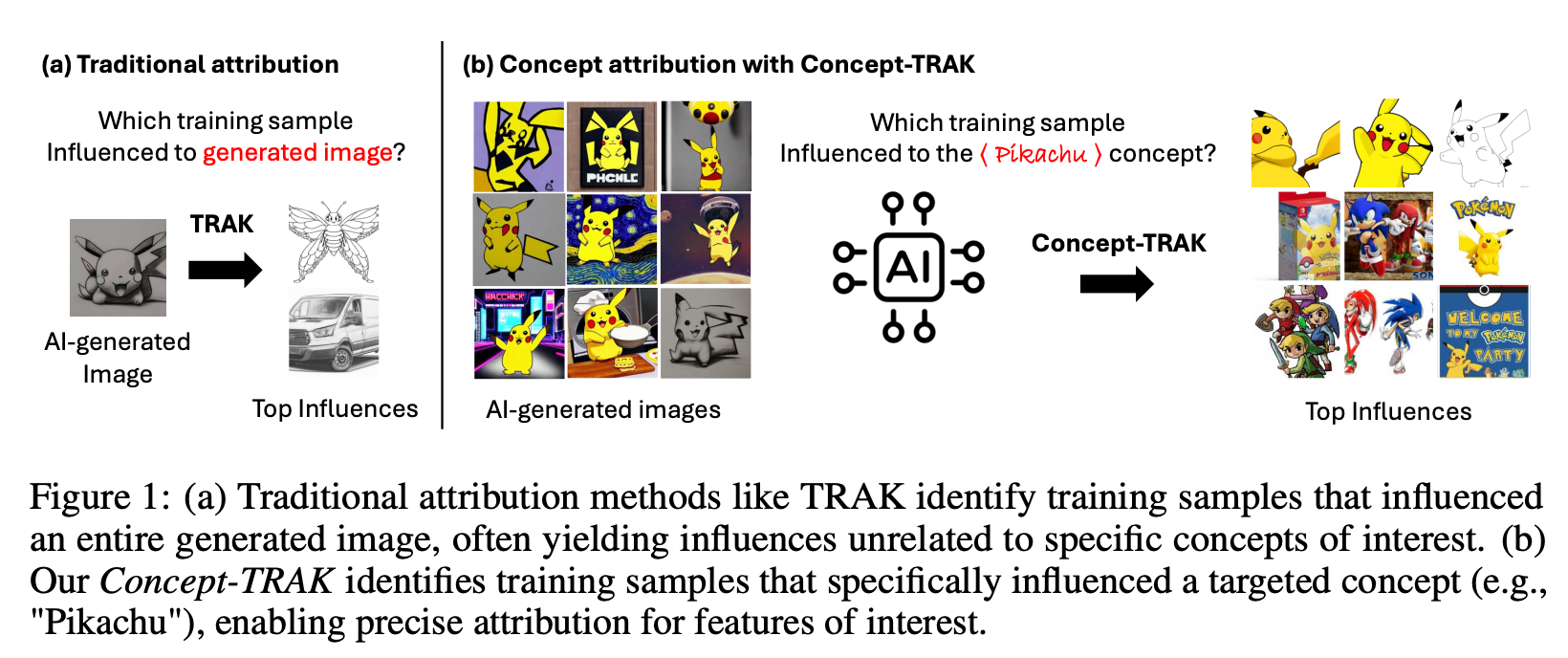
Diffusion models have shown a strong ability to generate images that reflect high-level concepts like objects, styles, attributes, and compositions. Yet how these concepts are learned and represented inside the model remains difficult to observe directly. Most interpretability tools look inside models at neurons or attention patterns, which are precise but hard to relate to the concepts people actually think in.
Concept-TRAK introduces a framework that shifts interpretability to the level of concepts themselves. Instead of asking which internal components activate, the method traces how specific visual concepts from the training data influence generation over time. In doing so, it reveals how semantic information enters and evolves throughout the diffusion process.
Why Concept-TRAK Matters and What Problems it Solves
Diffusion models are very good at creating images, but as more people use them, concerns about copyright and how these models work are growing. Current methods can show which training images influenced the final result, but they struggle to pinpoint what affected specific parts of an image, like its style or particular objects.
Concept-TRAK addresses this by linking generated images back to concept-level influences in the training set. Rather than pointing to abstract internal signals, it surfaces which training samples matter for specific concepts appeared in generation results.
Results and Takeaways
Through experiments across multiple diffusion models and datasets, the authors show that Concept-TRAK reliably identifies meaningful concept-level attributions.
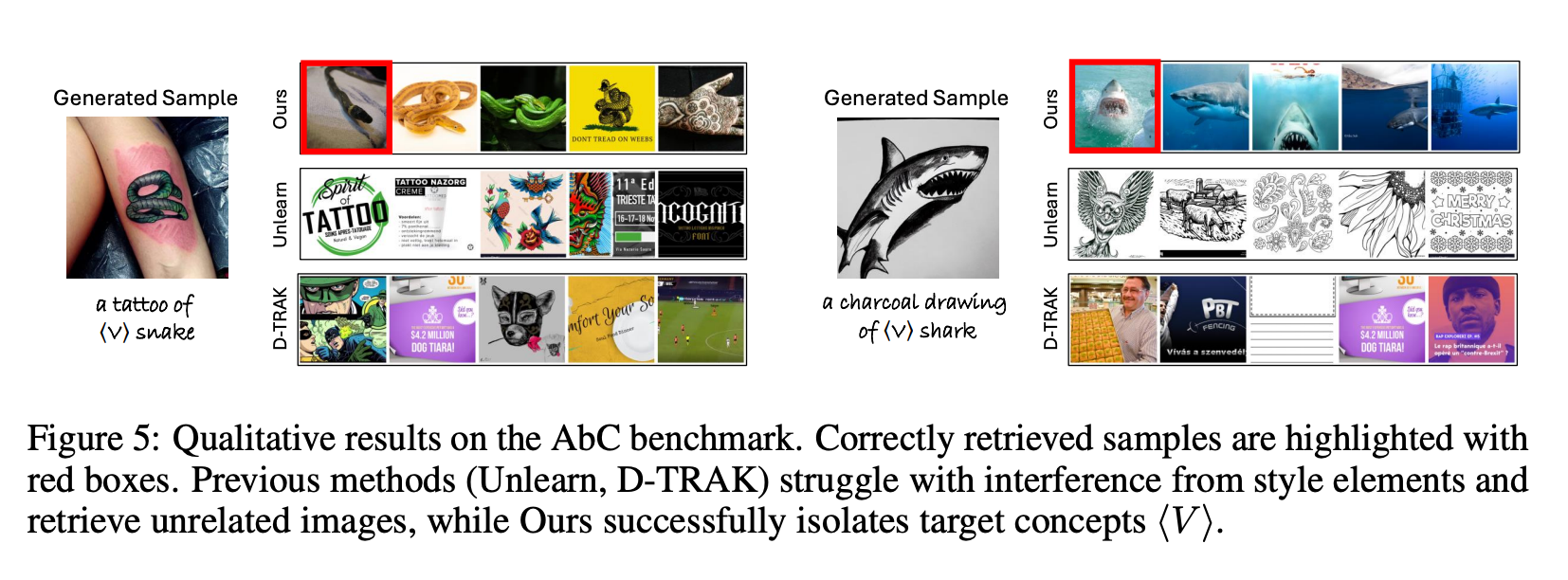
More broadly, Concept-TRAK provides a scalable and human-aligned approach to interpretability. By moving influence analysis from global to concept-levels, it makes training data attribution for diffusion models easier to understand for model owners and data providers.
Research:
VIRTUE: Visual-Interactive Text-Image Universal Embedder
Authors:
Wei-Yao Wang, Kazuya Tateishi, Qiyu Wu, Shusuke Takahashi, Yuki Mitsufuji (Sony Group Corporation; Sony AI)
Introduction to VIRTUE
Multimodal embedding models have become a core building block for search, retrieval, and recommendation across images and text. But most of these models assume that user intent can be expressed fully in language—even when what the user really wants to say is visual. VIRTUE addresses this gap by introducing visual interactivity directly into text–image embedding models. Instead of relying only on text prompts, users can specify a region of interest in an image using points, bounding boxes, or masks, and the model produces an embedding that represents the selected entity while still accounting for the holistic scene.
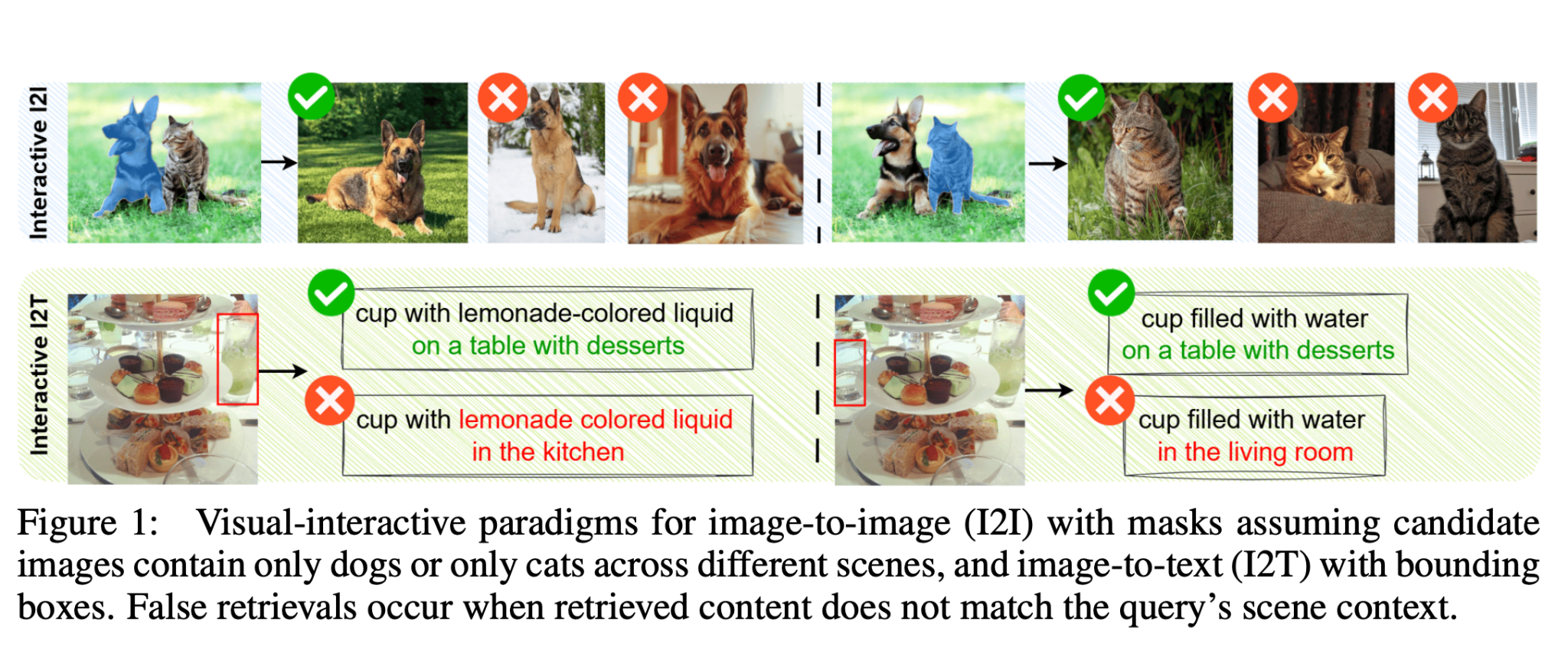
Built on a vision–language model backbone, VIRTUE integrates segmentation signals as first-class inputs, allowing embeddings to be grounded in both “what I’m pointing at” and “where it appears.” This shifts embeddings from being purely descriptive to being interactive and closer to how humans naturally work with images.
Traditional image–text embeddings struggle with localized intent. If a user wants “this object, not the whole image,” they typically have to translate that intent into words or rely on cropping, which often strips away important contextual information. VIRTUE solves this by letting users communicate intent visually, without sacrificing scene understanding.
This matters because context changes meaning. The same object can signal very different things depending on where it appears and what surrounds it. By combining entity-level cues from segmentation with global scene representations, VIRTUE avoids the common failure mode where models retrieve visually similar objects in the wrong setting.
For creators and visual practitioners, this enables more natural interaction with large image collections. Instead of carefully crafting prompts, you can point to what you care about and let the model infer intent. This approach mirrors how designers, artists, and editors already think and work with visual material.
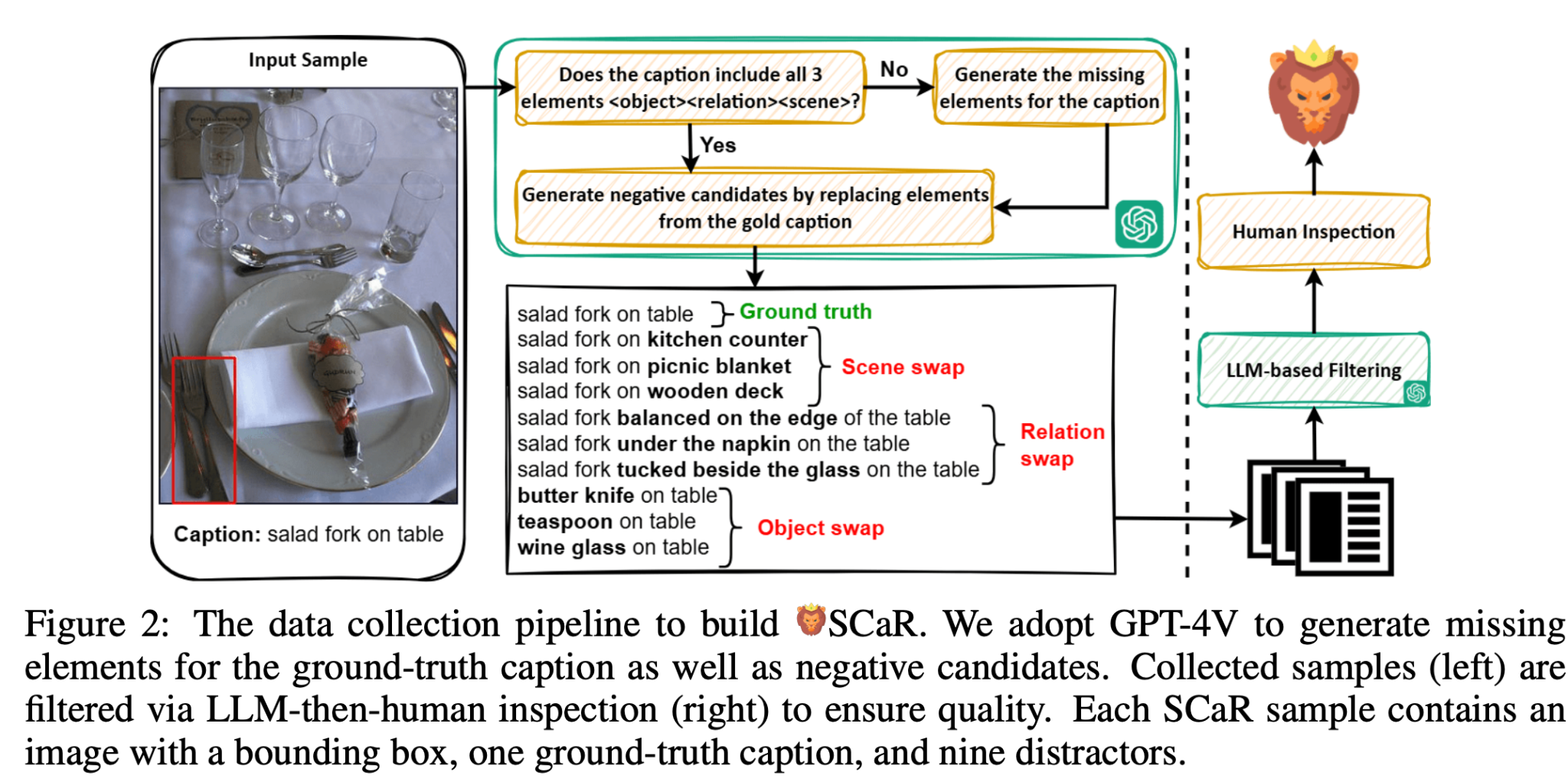
However, evaluating this kind of interaction has historically been difficult. Traditional embedding benchmarks were designed to measure global image–text matching, where a model compares an entire image to a caption. Interactive retrieval requires something different: reasoning about a specific object while still understanding the surrounding scene.
To study this capability, the authors introduce SCaR (Segmentation-and-Scene Caption Retrieval), a benchmark designed specifically for visual-interactive retrieval. In SCaR, a model receives an image along with a highlighted region and must retrieve the caption that correctly describes that object within its scene. The dataset contains one million samples drawn from multiple vision datasets and includes challenging “hard negatives” that differ subtly in object, relation, or scene for evaluating compositional and reasoning capabilities.
Results and Takeaways
Across conventional non-visual-interactive multimodal embedding benchmarks, VIRTUE shows consistent improvements over prior methods, with reported gains ranging from 3.1% to 8.5%. On the visual-interactive SCaR benchmark, which directly evaluates visual interactivity, improvements are substantially larger (between 15.2% and 20.3%), highlighting how preserving scene context helps models interpret localized user intent rather than relying on cropped inputs alone.
With visual interaction, VIRTUE enables new applications such as segment-level retrieval, where users select a region of interest to fetch semantically matching images, and entity-level hinting for on-the-fly correction, thereby extending the utility of embedding-based systems far beyond traditional global matching. More broadly, the results suggest that effective multimodal embeddings must capture not only relationships between images and text, but also the interactions that guide how users reference visual information. By treating pointing and region selection as part of the embedding process, VIRTUE demonstrates a path toward retrieval and discovery tools that feel more intuitive, flexible, and aligned with real creative workflows.
Code and models are available at: https://sony.github.io/virtue/
Research:
CMT: Mid-Training for Efficient Learning of Consistency, Mean Flow, and Flow Map Models
Authors:
Zheyuan Hu, Chieh-Hsin Lai, Yuki Mitsufuji, Stefano Ermon
Introduction to CMT
Diffusion models have become a dominant framework for generating images, audio, and other high-dimensional data. Recent work has introduced flow map models — a class of generative models that learn to make large jumps along the reverse diffusion trajectory, enabling high-quality generation in just a few steps. Prominent examples include consistency models, consistency trajectory model, and mean flow models.
However, training these models efficiently remains difficult. Flow map methods can be unstable, sensitive to hyperparameters, and computationally expensive to train at scale.
As the researchers put it, the core idea is to “rearrange the learning process rather than redesign the model,” reframing efficiency as a training problem rather than a modeling one.
Why CMT Matters
Training flow map models is difficult because the learning objective relies on approximations of the underlying diffusion trajectory. In existing methods, these targets are often produced by imperfect intermediate models during learning, which can introduce instability and slow convergence.
CMT addresses this by inserting an intermediate mid-training stage between teacher (diffusion) pre-training and flow map post-training. During this stage, the model learns to map intermediate states along a trajectory generated by a pre-trained teacher (diffusion) model directly back to the clean data sample. Because these targets stem from a fixed teacher trajectory, supervision is stable and well-defined.
The result is a trajectory-aligned initializer that makes subsequent flow map training faster, more stable, and easier to optimize.
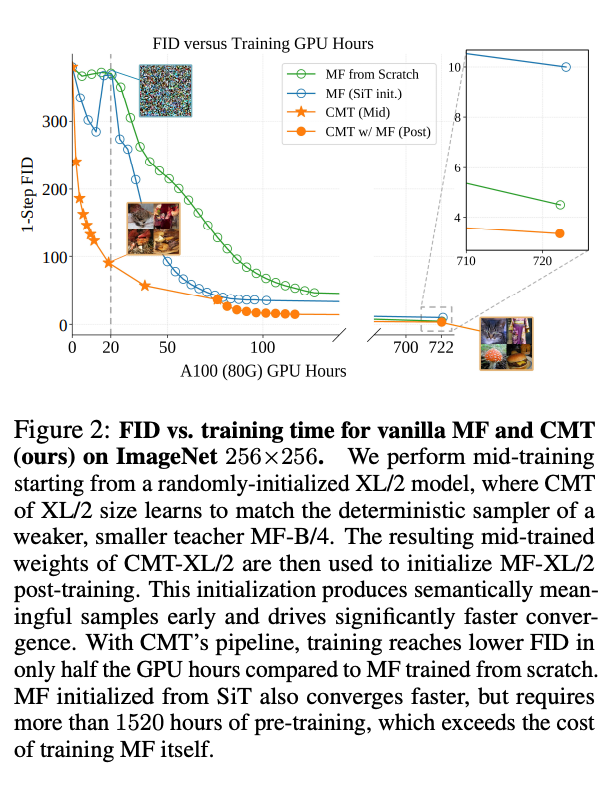
This is similar to learning to sketch before actually creating a painting. The mid-training phase gives the model a structural understanding of the data manifold (proportion, layout, motion) before asking it to master the fine-grained details required by a specific generative formulation. That early structure pays off downstream.
Results and Takeaways
Across multiple experiments, the authors show that models trained with CMT achieve comparable or better performance than standard training approaches, while requiring fewer training steps. The improvements are consistent across consistency models, mean flow models, and flow map models, demonstrating that the approach generalizes beyond a single architecture or objective.
One key takeaway is that mid-training is not a minor optimization but a structural intervention. By changing when certain learning signals are introduced, rather than what the model learns, CMT improves both stability and efficiency. The results suggest that training schedules deserve as much attention as model design — especially as generative models continue to scale.
More broadly, this work points toward a future where generative modeling frameworks are less siloed. Instead of treating consistency, diffusion, and flow models as separate tracks, CMT shows how shared training strategies can bridge them, making advanced generative tools more accessible and practical to deploy.
Code and models are available at https://github.com/sony/cmt
Research:
Improved Object-Centric Diffusion Learning with Registers and Contrastive Alignment
Authors:
Bac Nguyen, Yuhta Takida, Naoki Murata, Chieh-Hsin Lai, Toshimitsu Uesaka, Stefano Ermon, Yuki Mitsufjuji
Introduction to the Research
When editing or interacting with images generated by diffusion models, it is often difficult to target a single object without affecting the rest of the scene. For example, changing the color, position, or presence of one object can unintentionally alter nearby textures, lighting, or background elements. While diffusion models can produce visually coherent images, their internal representations tend to entangle objects with their surroundings, making object-level control and reasoning unreliable.
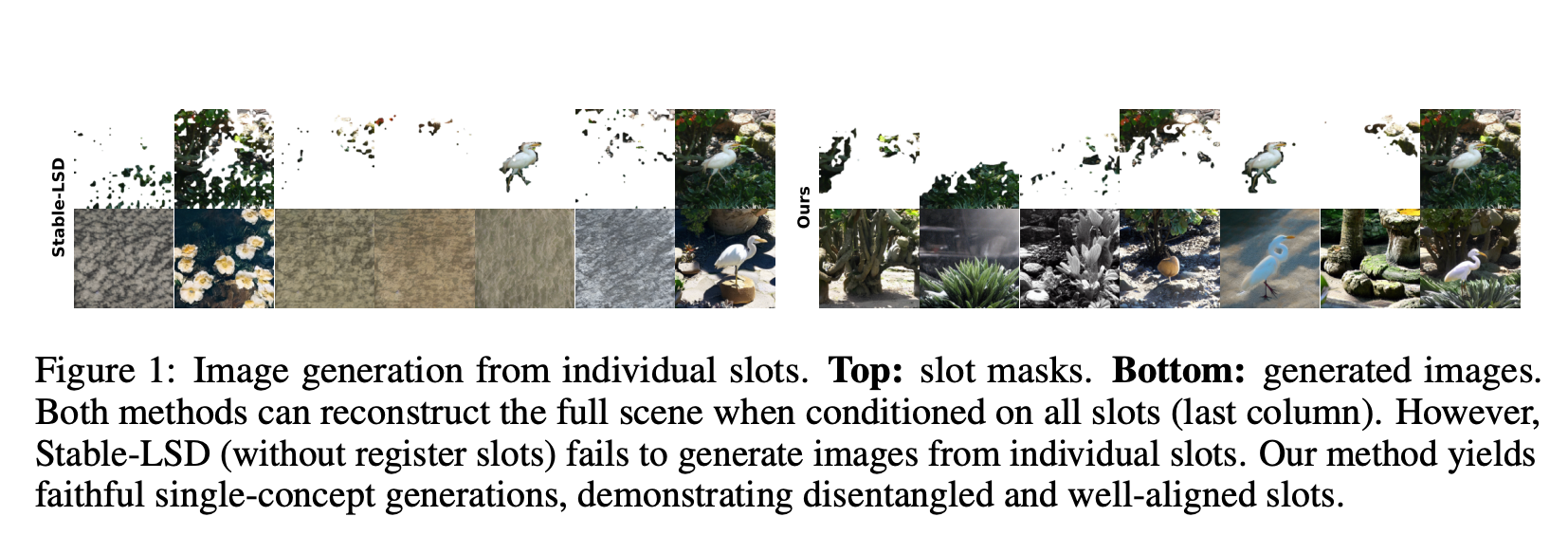
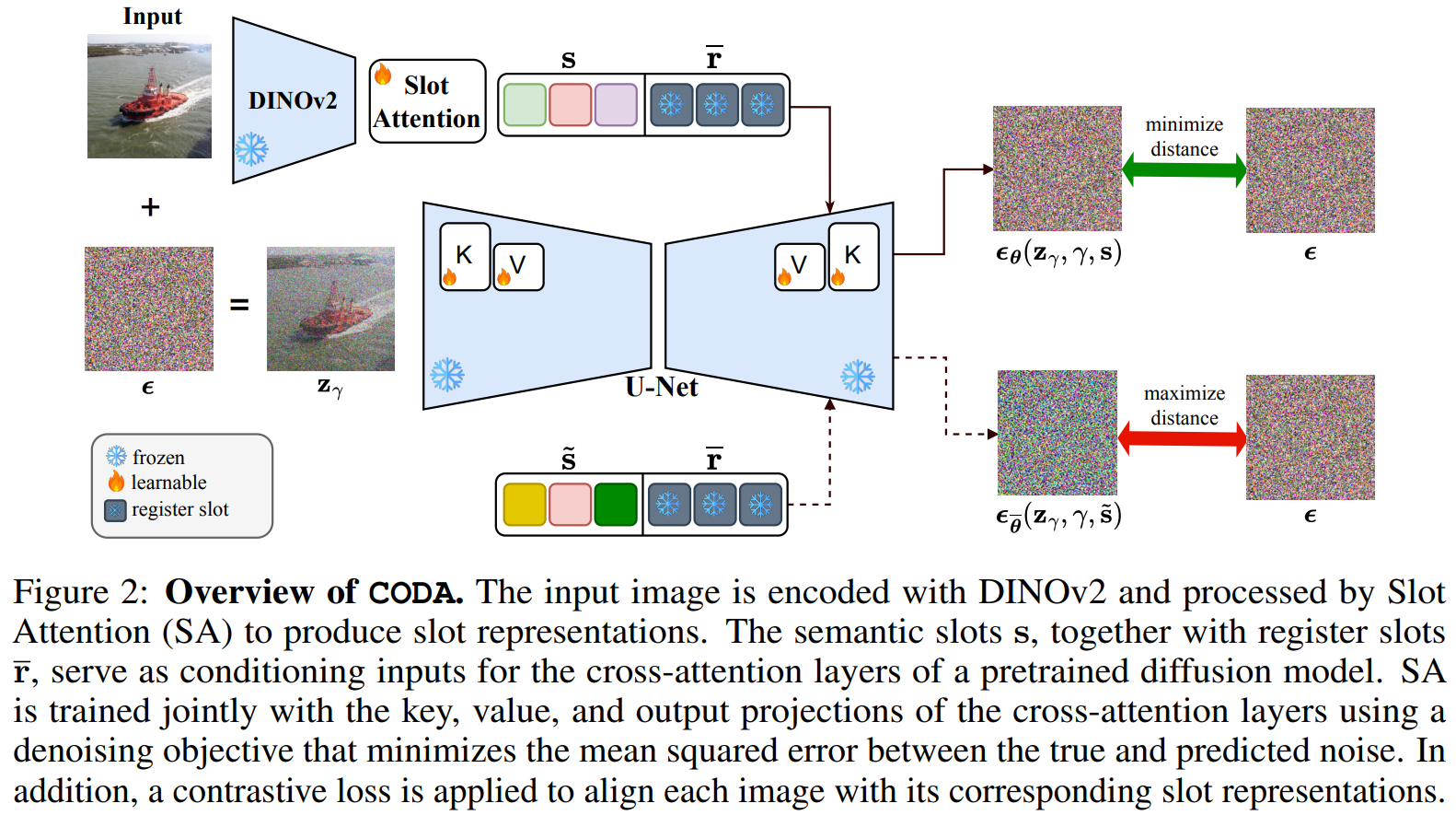
This paper addresses that limitation by improving how diffusion models learn and represent objects as distinct entities. The authors propose an object-centric approach that encourages models to treat scenes as compositions of persistent objects rather than as undifferentiated pixel fields. Their method introduces registers, or dedicated representation slots for shared or background information and preventing object slots from mixing, along with a contrastive alignment objective that ensures slots capture concepts present in the image.
Together, these additions steer diffusion models toward learning scenes in a more structured, object-aware way, without requiring heavy supervision or a complete architectural redesign.
Why it Matters, What Problems it Solves
Many practical applications of generative models depend on reliable object-level understanding. Image editing, interactive design tools, scene manipulation, and visual reasoning all require the ability to isolate one object while leaving others unchanged. When object information is entangled with background or texture, even simple edits can cascade into unintended changes.
Diffusion models face a particular challenge here because they generate images through a sequence of noisy intermediate states. Object identity can drift, fragment, or blend with other elements as noise is added and removed. The result is a model that produces realistic images but lacks stable internal representations of “things” within those images.
The register slots introduced in this work act as attention sinks, absorbing residual attention mass so that semantic slots remain focused on meaningful object–concept associations. This reduces interference between object slots and mitigating slot entanglement. Contrastive alignment then reinforces this image-slot structure by explicitly aligning slots with image content while discouraging overlap between different slots. Instead of rediscovering objects from scratch at every step, the model learns to keep track of them as distinct entities throughout the generation process. For creators and tool builders, this opens the door to more dependable object-level control, making edits more localized, interactions more predictable.
Results and Takeaways
The authors demonstrate that combining register slots with contrastive alignment yields clearer and more stable object representations within diffusion models. In their experiments, models trained with this approach demonstrate improved object persistence across diffusion steps and better separation between objects and background.
This work reinforces a growing theme in diffusion research: improving internal structure often matters as much as improving raw generative quality. By helping diffusion models represent scenes as collections of objects, this paper brings them closer to being tools that can be edited, guided, and reasoned about — not just admired for visual realism.
Research:
SONA: Learning Conditional, Unconditional, and Matching-Aware Discriminators
Authors:
Yuhta Takida, Satoshi Hayakawa, Takashi Shibuya, Masaaki Imaizumi, Naoki Murata, Bac Nguyen, Toshimitsu Uesaka, Chieh-Hsin Lai, Yuki Mitsufuji
Introduction to SONA
Generative models are often trained with discriminators that try to judge whether generators’ outputs look real or fake under given conditions. In practice, however, conditional discriminators have to assess authenticity and conditional alignment of generated and data samples, which should be well balanced for good performance.
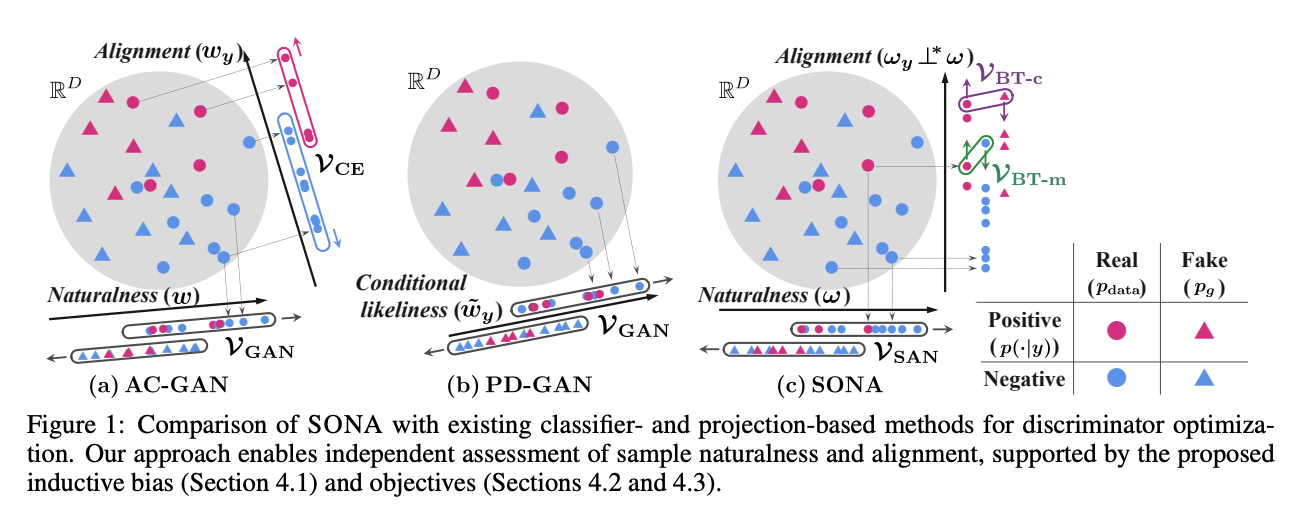
This paper introduces SONA, a discriminator training framework designed to balance the dual objectives of assessing authenticity and conditional alignment. Instead of simply considering training samples and generated samples as real and fake samples, respectively, SONA learns to distinguish among conditional, unconditional, and mismatched input–output pairs within a unified training objective. The proposed framework makes adversarial training of generative models more efficient and applicable to complex conditioning such as text prompting.
Why SONA Matters, What Problems it Solves
Deep generative modeling has achieved remarkable progress in synthesizing contents. Nevertheless, generating high-quality samples that are well-aligned with conditional information, such as class labels or text prompts, remains a central problem due to challenges of balancing the dual objectives of unconditional discrimination and conditional alignment.
SONA addresses this gap by explicitly modeling mismatches during training. Rather than treating incorrect conditioning as an edge case, the discriminator is trained to recognize when generated outputs do not align with the provided condition. This allows the generator to receive more informative feedback, even when conditions are weak or partially incorrect.
A concrete way to think about this is feedback quality. A discriminator that only checks “real or fake” under perfect conditions provides limited guidance when inputs deviate from expectations. By contrast, a matching-aware discriminator can signal not just realism, but alignment, whether the output actually corresponds to what was asked for.
Results and Takeaways
The authors show that incorporating conditional, unconditional, and matching-aware signals into discriminator training leads to more stable learning and improved performance across tasks. In controlled experiments, SONA consistently outperforms projection-based and classifier-based baselines as the number of conditions increases, avoiding mode collapse and class confusion.
One key takeaway is that discriminator design plays a critical role in shaping generative behavior. Rather than increasing model size or adding auxiliary losses, SONA improves outcomes by expanding what the discriminator is trained to notice.
More broadly, this work reinforces a recurring theme across ICLR 2026: training objectives matter as much as architectures. By aligning discriminator feedback with real usage scenarios, SONA contributes to generative models that are not only higher quality, but more dependable when conditions are imperfect.
Research:
LLM2Fx-Tools: Tool Calling for Music Post-Production
Authors:
Seungheon Doh, Junghyun Koo, Marco A. Martínez-Ramírez, Woosung Choi, Wei-Hsiang Liao, Qiyu Wu, Juhan Nam, Yuki Mitsufuji
Introduction to LLM2Fx-Tools
Music post-production relies heavily on applying sequences of audio effects — equalization, compression, reverb, delay — arranged into carefully ordered effect chains. Designing these chains typically requires expert knowledge and iterative manual tuning, especially when attempting to match the sound of a reference track.
This paper introduces LLM2Fx-Tools, a multimodal framework that uses large language models to infer executable audio effect chains directly from audio and instructions. Given a reference track, optional dry audio, and natural language guidance, the system estimates not only an ordered sequence of audio effects with parameters, but also an explicit reasoning trace and tool calls that can be executed by real audio plugins.
As the authors describe it, the goal is to generate “executable sequences of audio effects (Fx-chain) for music post-production,” rather than static predictions or opaque parameter estimates.
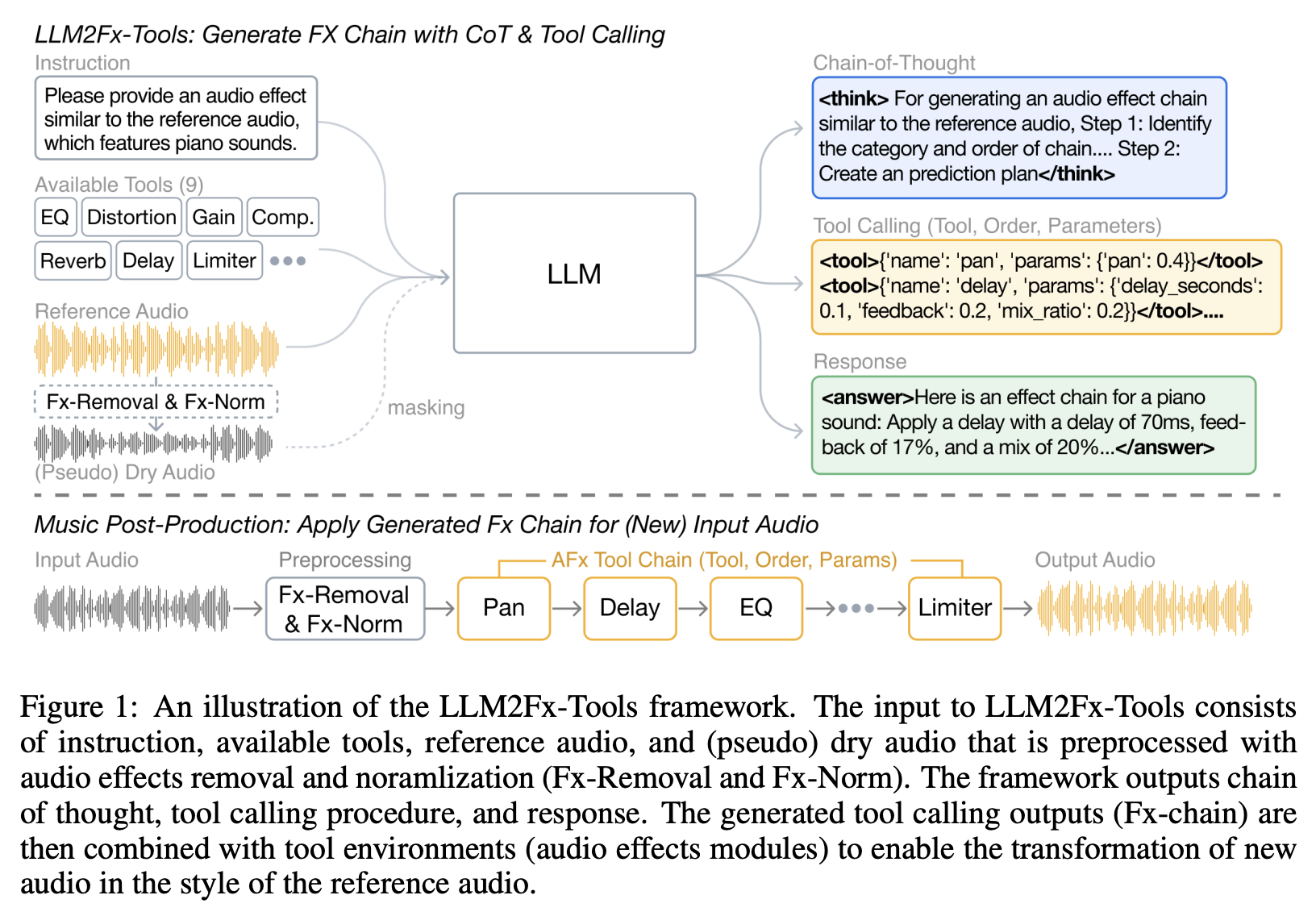
Why LLM2Fx-Tools Matters
Previous approaches to automatic effect-chain estimation tend to fall into two camps: signal-processing or regression-based methods that operate on fixed configurations, and gradient-based approaches that require differentiable audio effects. Both limit flexibility and make it difficult to adapt to real-world production workflows.
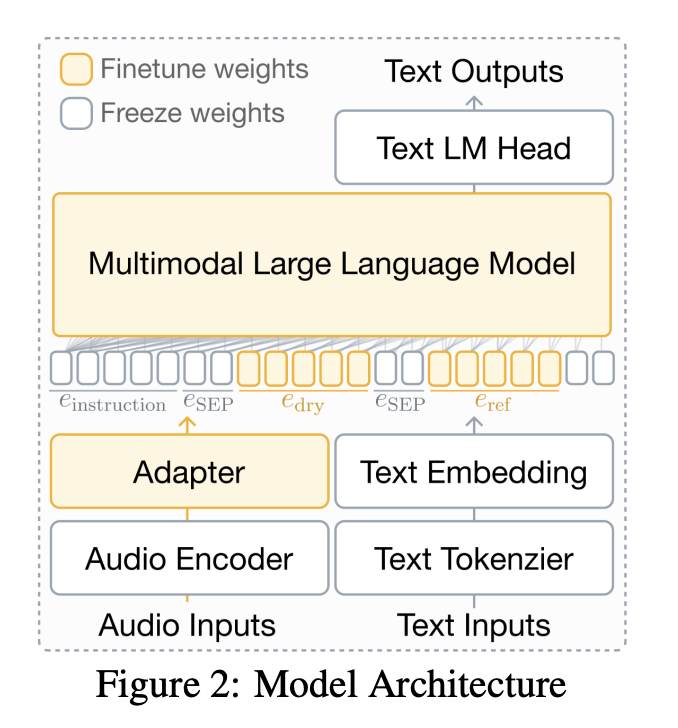
LLM2Fx-Tools addresses this by treating audio effects as external tools rather than internal model components. Tool calling allows the system to work with non-differentiable effects, while chain-of-thought reasoning decomposes the task into interpretable steps: selecting effects, determining their order, and estimating parameters.
The researchers are explicit about this motivation, noting that prior methods “lack the ability to dynamically select effects and determine their ordering” and “lack user-level interpretability” (Section 1). By contrast, LLM2Fx-Tools exposes its reasoning in human-readable form, bridging the gap between expert practice and automated systems.
A useful way to think about this system is as a planning assistant rather than a black-box predictor. Instead of guessing parameters all at once, it reasons through the structure of a mix the way a human engineer might—deciding what to apply, in what order, and why—before executing those decisions through tools.
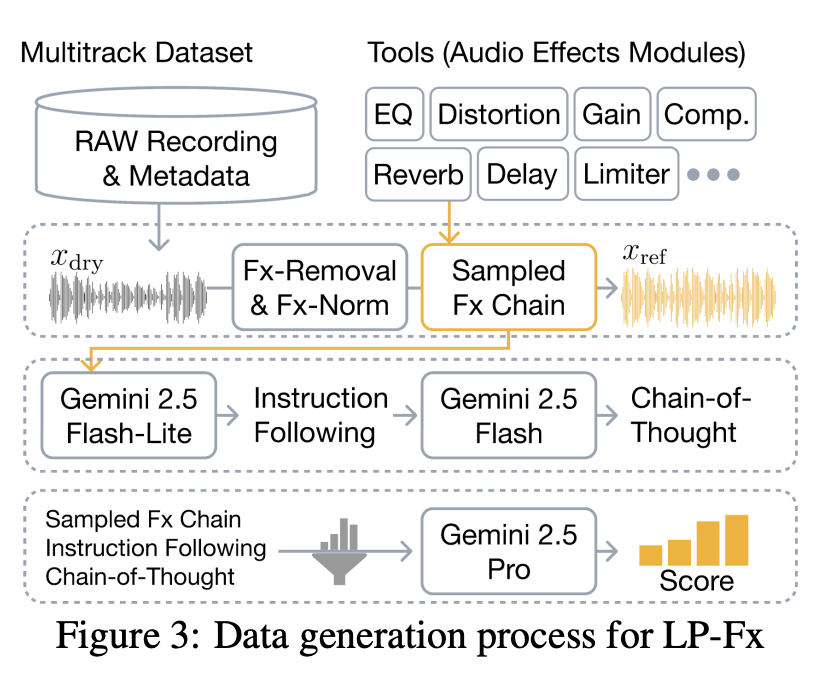
For creators and audio engineers, this supports workflows where transparency and controllability matter as much as the final sound. It enables iteration, inspection, and adjustment, rather than replacing expertise with an opaque model output.
Results and Takeaways
Across reverse-engineering and style-transfer tasks, LLM2Fx-Tools consistently outperforms regression, multitask, and differentiable signal-processing baselines. In effect-chain planning, it achieves higher accuracy in identifying which effects are present and significantly better correlation in predicting their correct order, the researchers explain.
One result highlighted by the authors is that correct effect ordering materially improves perceptual similarity. As they observe, “correct effect sequencing significantly contributes to audio processing quality,” reinforcing that structure — not just parameter accuracy — is central to realistic post-production.
In blind style-transfer experiments, where effects inferred from one track are applied to different audio content, LLM2Fx-Tools shows stronger generalization than both traditional baselines and closed-source multimodal models. Human listening tests further confirm that its outputs are perceptually closer to reference audio than competing methods, the authors note.
The broader takeaway is that combining tool calling with structured reasoning enables a new class of generative systems; ones that are both powerful and inspectable. By emitting executable tool chains rather than raw predictions, LLM2Fx-Tools demonstrates how language models can act as intermediaries between intent, reasoning, and real-world creative tools.
Demo Available at: https://seungheondoh.github.io/llm2fx-tools-demo/
Research:
3D Scene Prompting for Scene-Consistent Camera-Controllable Video Generation
Authors:
JoungBin Lee, Jaewoo Jung, Jisang Han, Takuya Narihira, Kazumi Fukuda, Junyoung Seo, Sunghwan Hong, Yuki Mitsufuji, Seungryong Kim
Introduction to the Research
Camera-controllable video generation aims to let users specify how a virtual camera should move while a video is generated. Recent approaches have made progress by conditioning on a small number of input frames, but they struggle to maintain consistency when videos are long or when the camera revisits parts of a scene that appeared much earlier.
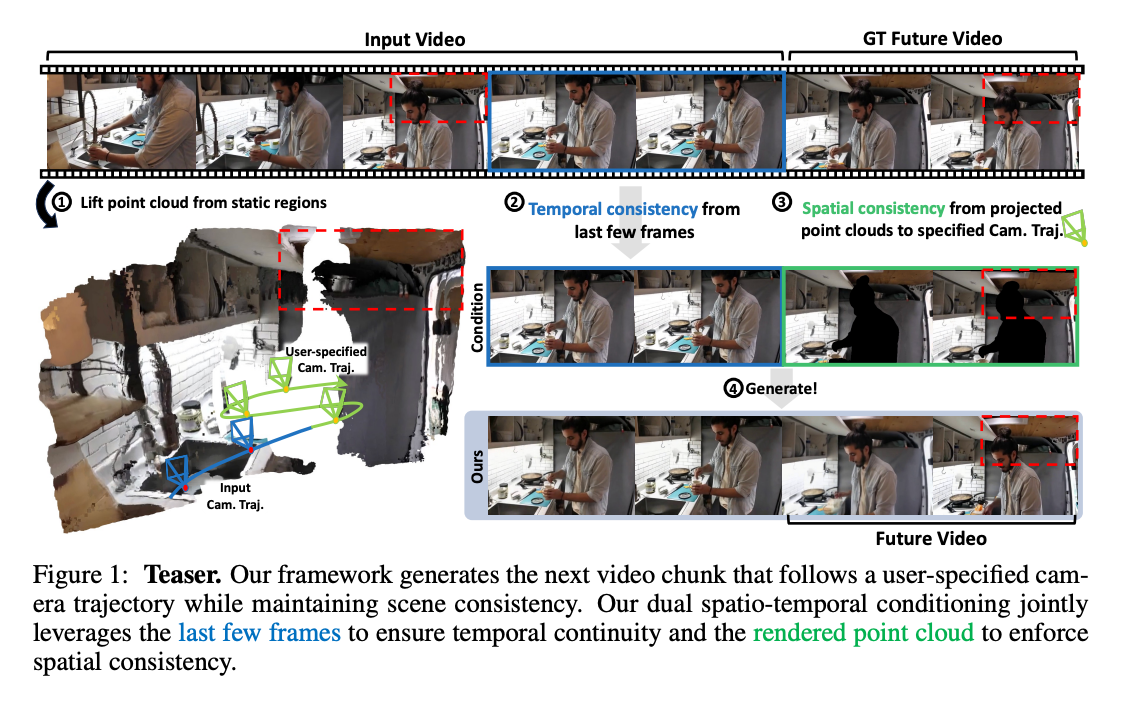
As the authors note, existing methods “can only process extremely short conditioning sequences, typically just a few frames,” which limits their ability to preserve global scene context over time.
This paper introduces 3DScenePrompt, a framework that maintains scene consistency by grounding video generation in a persistent 3D representation of the environment. Rather than relying solely on nearby frames, the method uses a reconstructed 3D scene as a spatial reference, allowing the model to project previously observed parts of the scene into new camera viewpoints.
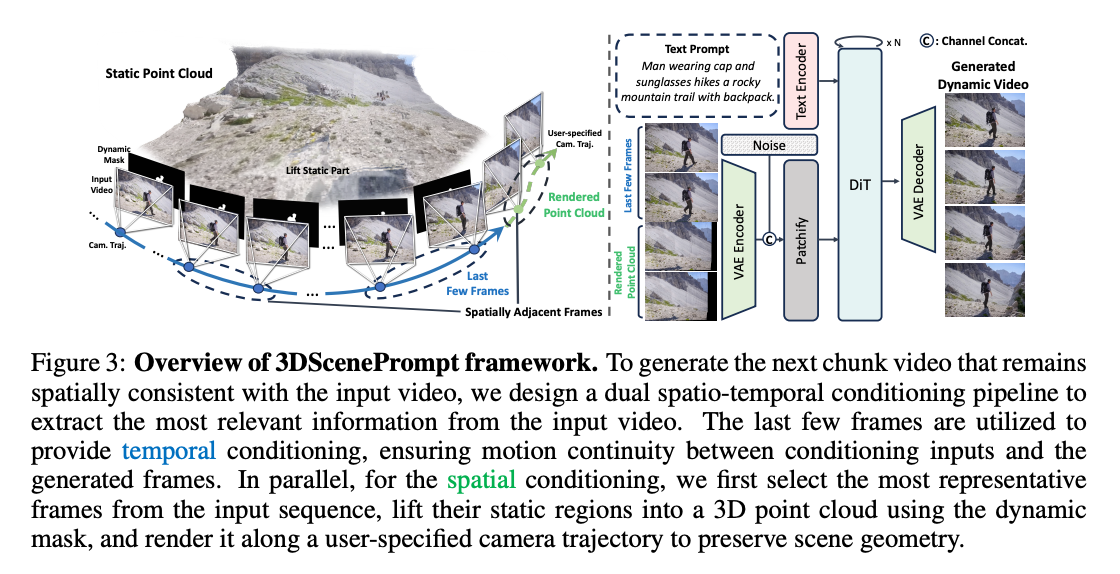
Conceptually, this is similar to drawing a map of a place first and then filming inside that map. The camera is free to move, but the world itself remains consistent because the layout is already known.
Why this Research Matters & What Problems it Solves
The core challenge in camera-controllable video generation is balancing spatial consistency with temporal realism. Static elements such as buildings, walls, or terrain should remain stable, especially when the camera revisits them from different angles. At the same time, dynamic elements like people or vehicles should continue to evolve naturally rather than being frozen in time.
The authors describe this tension directly, noting that “static scene elements should remain consistent throughout generation, [while] dynamic elements such as moving objects and people should evolve naturally from their most recent states.”.
3DScenePrompt addresses this by separating spatial memory from temporal motion. A 3D scene representation captures long-term, static structure across the entire input video, while short-term frame conditioning preserves recent motion. This design prevents the model from reintroducing outdated dynamic content while still enforcing geometric consistency.
Results and Takeaways
Across multiple datasets and camera trajectories, 3DScenePrompt outperforms prior methods in scene consistency, camera controllability, and overall visual quality. The method achieves higher PSNR and SSIM scores and substantially lower geometric inconsistency when the camera returns to previously seen viewpoints.
One particularly notable result is the reduction in multi-view geometric error. The authors report that their approach reduces alignment error by 77% compared to a strong baseline, demonstrating significantly improved spatial coherence over long sequences.
The broader takeaway is that long-horizon video generation benefits from explicit spatial memory. By introducing 3D scene prompting, this work shows how video models can preserve a stable understanding of the world while allowing motion and dynamics to unfold naturally; a key step toward controllable, coherent video generation for complex scenes.
The authors provide a dedicated project page with visual results and supporting material: https://cvlab-kaist.github.io/3DScenePrompt
Research:
Theory-Informed Improvements to Classifier-Free Guidance for Discrete Diffusion Models
Authors:
Kevin Rojas, Ye He, Chieh-Hsin Lai, Yuhta Takida, Yuki Mitsufuji, Molei Tao
Introduction to the Research
Classifier-free guidance (CFG) has become a standard technique for steering diffusion models toward desired outputs without relying on an external classifier. While CFG is well understood and widely used in continuous diffusion models, its application to discrete diffusion models (such as those used for text, symbolic data, or token-based generation) is less well grounded theoretically.
This paper examines classifier-free guidance in the discrete setting and identifies a mismatch between how CFG is commonly applied and how discrete diffusion processes behave mathematically. As the authors observe, “existing classifier-free guidance methods for discrete diffusion models are not theoretically well-justified.”
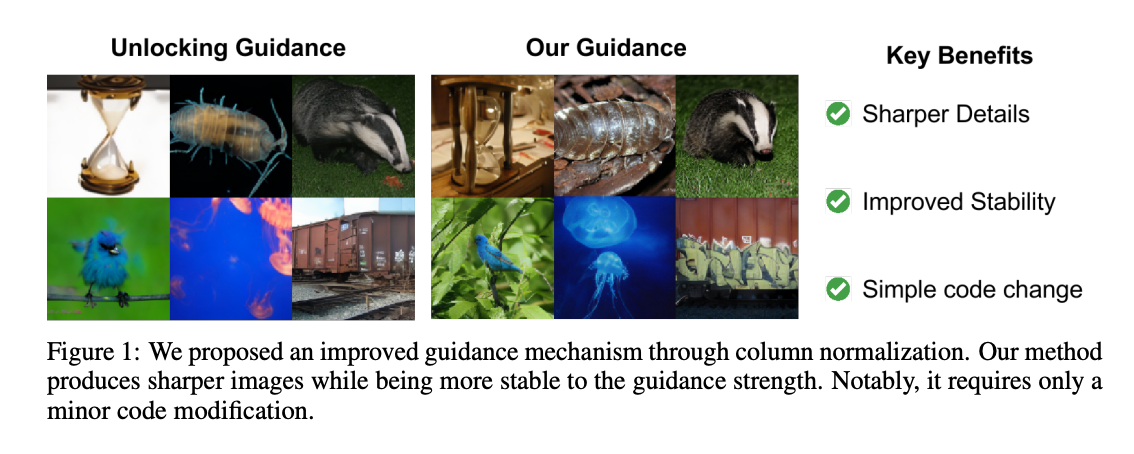
Conceptually, the issue is less about tuning a parameter and more about applying the correct guidance rule for the system being modeled. Classifier-free guidance was originally derived for continuous diffusion models, but applying the same formulation in discrete diffusion introduces subtle theoretical differences. As the authors note, existing implementations can “unintentionally cause imbalanced transitions, such as unmasking too rapidly during the early stages of generation, which degrades the quality of the resulting samples.” This work revisits the derivation and proposes a corrected guidance rule tailored to discrete diffusion settings.
Why the Research Matters
In practice, applying CFG naively to discrete diffusion models can lead to unstable or degraded behavior. Increasing the guidance scale may improve conditional alignment, but it often does so at the expense of sample quality or diversity. This is a trade-off that practitioners observe empirically but that standard formulations do not fully explain.
The authors trace this behavior to a theoretical inconsistency, showing that “the guidance formulation commonly used in discrete diffusion deviates from the theoretically correct objective”. When guidance is applied in this way, it can push the model in directions that are incompatible with the underlying diffusion process, especially as guidance strength increases.
By grounding classifier-free guidance directly in discrete diffusion theory, the proposed method resolves this mismatch. The resulting guidance behaves more predictably across a wider range of guidance scales, reducing failure modes without sacrificing conditional control.
For researchers and practitioners, this reframes CFG from a heuristic knob into a method whose formulation matters, particularly in discrete domains where small inconsistencies can accumulate across many diffusion steps.
Results and Takeaways
The authors evaluate their theory-informed guidance across multiple discrete diffusion tasks and consistently observe improved behavior compared to standard CFG. The modified guidance achieves stronger conditional alignment while maintaining, and in some cases improving, generation quality.
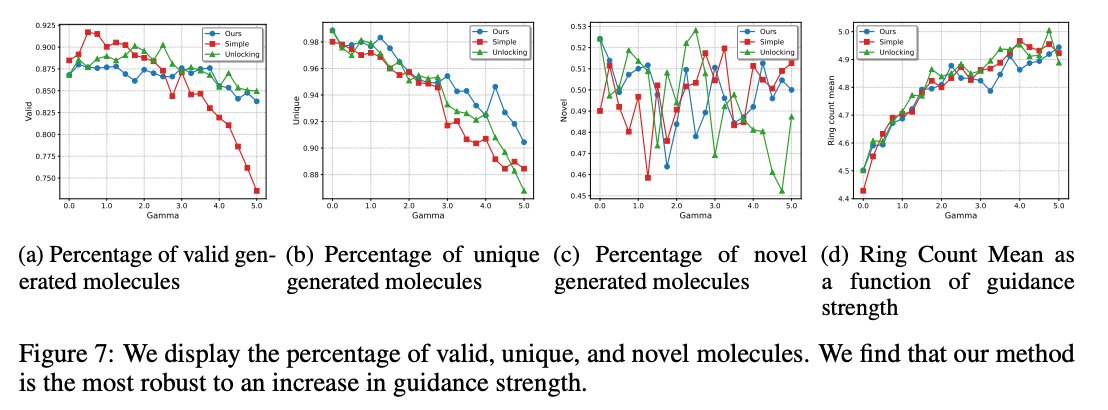
A key empirical result is improved robustness at higher guidance scales. The researchers report that the proposed method “significantly mitigates the degradation in generation quality observed with conventional classifier-free guidance at large guidance scales.”
The broader takeaway is that guidance mechanisms are not universally transferable across diffusion paradigms. Techniques derived for continuous diffusion do not automatically extend to discrete settings. By revisiting the theoretical foundations of classifier-free guidance, this work strengthens a widely used tool and makes discrete diffusion models easier to control and deploy reliably.
Authors:
Ouns El Harzli, Bernardo Cuenca Grau, Artur D’Avila Garcez, Ian Horrocks, Tarek R. Besold
Introduction
Modern neural networks are increasingly expected to reason — to combine information, propagate constraints, and arrive at conclusions in structured ways. At the same time, logic remains the most precise language we have for describing reasoning, offering formal semantics, guarantees, and verification tools. This paper sits at the intersection of those two traditions.
The work revisits fibring, a concept from logic that describes how multiple logical systems can be combined into a single, coherent framework. Fibring also inspired an early neurosymbolic idea: fibred neural networks, where one network dynamically influences another during computation. While the neural formulation drew inspiration from logic, the relationship between the two had remained informal. As the authors note, “fibring of neural networks was introduced as a neurosymbolic framework for combining learning and reasoning in neural networks. However, the exact correspondence between fibring of neural networks and fibring of modal logics was never formally established.”
This paper establishes that correspondence rigorously. It shows that the computations performed by fibred neural networks can be interpreted exactly as the evaluation of formulas in a corresponding fibred modal logic. In doing so, it provides a formal bridge between neural computation and logical semantics.
Why Does This Research Matter?
As neural models grow more complex, understanding and validating their behavior becomes increasingly difficult. Logic offers a complementary perspective: it provides clear definitions of validity and expressiveness, along with tools for formal verification. The authors are explicit about this motivation, arguing that “logical reasoning is arguably the best perspective to study and develop this capability, offering precise definitions, validity conditions and a formalism that is amenable to formal verification.”
By grounding fibred neural networks in modal logic, this research opens a path toward interpreting what such networks learn in logical terms. Rather than inspecting internal activations or weights, the framework allows researchers to reason about network behavior at the level of logical theories. The authors describe this aim directly: “the goal of this paper is to open the way for the use of fibring as a formalism for interpreting the logical theories learnt by neural networks with the tools of computational logic.”
The technical core of this research proves an exact equivalence between fibred neural networks and a fragment of fibred modal logic. Under this correspondence, running a fibred neural network on an input aligns precisely with evaluating a logical formula on a compatible model: “evaluating the fibred network on an input corresponds exactly to checking the truth value of the associated fibred logical formula.”
Results and Takeaways
Building on this result, the authors apply the framework to widely used architectures, including Graph Neural Networks, Graph Attention Networks, and Transformer encoders. They show that these models can be characterized non-uniformly using fibred neural networks, and therefore described by corresponding logical formulas. In their words, “fibred neural networks can be used to non-uniformly describe large classes of GNNs, GATs and Transformer encoder architectures.”
The broader implication is a unifying perspective on neural expressiveness. GNNs and Transformers are often studied using different tools, despite deep structural similarities. Fibring offers a common formal language for analyzing both, and suggests a route toward future results in interpretability and verification.
As the authors conclude, they believe that fibring “has the potential to enable the unification of expressiveness results for various network architectures, with future applications in interpretability and verification.”
Further Reading
To explore prior year’s ICLR research from us, please dive into the following recaps from year’s past: